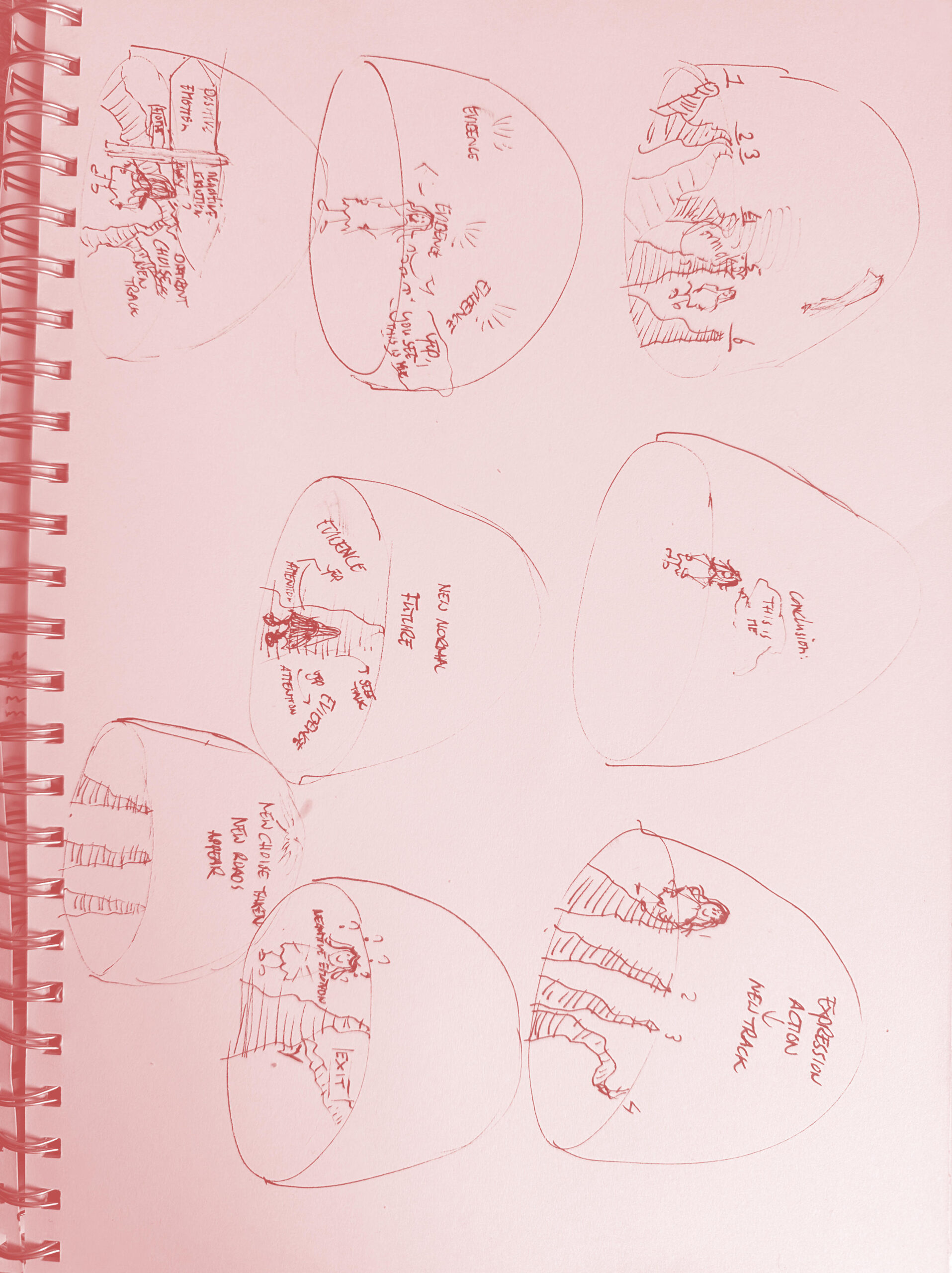
Switching tracks
This page is for the moment where I realise i’m lost inside the reflection.
- Notice. Oh… off track…
- Stop fixing. Noting inside the snow globe can be solved before I return to myself.
- Contact. Inside of the feet. Inside of the hands. Feel the mattress, the floor. Let gravity win.
- Soften. Let the body release one more layer of letting go.
- Feel the shift. Don’t lead the shift with your head. Let the body lead. Let feeling lead.
- Choose again. When clarity returns make the next real choice.
Softness is not a reward for fixing at all; it is the doorway home.
Switching Tracks
This page is for the moments when I forget how to get back.
When I can no longer tell whether there is something to solve, a choice to make, or simply an emotion that needs to be felt.
When I’m entangled with an outcome.
When I’m fighting what is already here.
When I’m replaying a choice that has already been made.
When fear turns into thinking, fixing, managing, explaining or predicting.
In those moments, I am still steering.
But I am steering from inside a belief.
Fear tells me what the situation means.
Old conclusions tell me who I am.
Imagination fills in what might happen next.
And choices made from there easily keep laying track through familiar territory.
The way out is not to stop steering.
It is to come back to clarity before I steer again.
I am the current.
The only place I can steer from is here.
And the only choice available to me is the next one.
Sometimes that next thing is action.
Sometimes there is a decision to make.
Sometimes there is a real problem that is mine to solve.
And sometimes there is nothing to do yet because what is asking for my attention is the emotion itself.
When I cannot tell the difference, I stop.
I feel the contact points.
I let the body carry what is here.
I stop arguing with the emotion, explaining it or trying to make it disappear.
I let it move through the instrument.
Not so that I can force myself into a better state.
Not so that I can manufacture the right answer.
I wait until there is enough quiet to see again.
Then I ask:
Is there something here that is mine to solve? Is there a choice that is mine to make? Or am I trying to change something that has already happened?
What is already here cannot be unchosen.
I can replay the old choice in my imagination a thousand times, but there is no steering wheel there. It costs time, attention and energy without moving the train an inch.
The steering wheel is here. The choice is now.
So I feel what needs to be felt.
I see what is actually here.
And then I choose again.
A choice from belief tends to repeat familiar track. A choice from clarity can open new territory.
This page is not here to give me the right answer.
It is here to bring me back to the place from which I can choose.
When I try to solve a belief
Sometimes I am not solving what is actually here.
I am fighting a belief.
The belief says there isn’t enough, so I work harder to create enough.
The belief says I’m not safe, so I try to control the outcome.
The belief says I’m not enough, so I try to prove myself.
From inside the belief, the response makes perfect sense.
But fighting the belief keeps my attention on it.
I think about it.
I argue with it.
I react to it.
I organize my choices around it.
And so I keep rehearsing the same route.
The harder I fight the old track, the more of my attention and energy I keep giving to it.
This is where I need to stop trying to win.
First, recognize:
This is what I believe right now.
Then acknowledge what that belief is doing in me:
I don’t feel safe, and I want to control.
I believe there isn’t enough, and I want to create more.
I feel that I’m not enough, and I want to prove myself.
Then accept.
Not: this belief is true.
But:
This belief is here. This emotion is here. This is what my instrument is carrying right now.
I let the emotion be felt instead of turning it immediately into another action.
I stop fighting what is already here.
And when the resistance softens enough for me to see clearly again, I can choose.
Not against the old belief. Not to prove it wrong. Not to escape the emotion.
I make the next choice from what I can actually see now.
And that choice can take me somewhere the old belief could not.
A different choice creates different experience.
Different experience brings different evidence.
And slowly, the old track stops being the only track I can see.
How does this feel in the body?
Sometimes it starts in the toes.
Sometimes in the chest.
Sometimes in the hips — especially when I’ve been holding for days.
The moment I stop trying to solve the storyline
and let myself feel what is actually here,
something begins to shift.
It might feel like:
- a soft ache in the belly
- pressure on the tongue
- tension melting from the upper legs
- a cold shiver through the spine
- the beginning of a yawn, like a doorway opening
- tears arriving without a story attached
- a quiet tremble that grows when I don’t interfere
- warmth returning to the hands and feet
- a deeper breath that wasn’t available five minutes ago
And then — sometimes suddenly, sometimes slowly — the shaking may begin.
Not as something I make happen.
I stop doing, and something in the body starts doing itself.
The field moves through the instrument.
The body responds in its own way.
I don’t have to explain it.
I don’t have to make something happen.
I don’t have to turn it into another task.
I stay with the contact points.
I feel.
I let the movement finish in its own time.
And somewhere inside that, I remember:
This is how I shift. This is how clarity returns. And from here, I can choose again.
The body is quieter than the mind
This is the part I easily forget.
The mind is loud and the body is quiet.
Solving can feel faster than softening.
Reacting feels like doing something, while lying down and feeling can look like doing nothing.
But when emotion is steering, more thinking does not necessarily bring more clarity.
Sometimes the next movement is much simpler:
Stop. Feel. Let the body have what is already here.
Then, when the noise settles, look again.
Clarity first. Choice second.
Try it Yourself – The Triad Practice: Letting Go as Entry Point
1. The Ridge (Recognition)
Gently notice it. That slight tension — the ridge of “not now.”
It might feel like a tightening in the chest, a thought that flickers by,
or just an absence of breath.
No need to fix it.
Just notice it — like mist rising from warm ground.
2. The Click (Decision + In-Breath)
Let the decision arise: “Yes. Now.”
Not because you must.
But because you’re ready to be danced.
Then allow one deep, soft in-breath.
No forcing. Just the kind of breath that the body takes when it knows it’s safe.
3. The Drop (Contact Point + Gravity)
Feel a contact point.
Could be your hips on the chair,
your feet on the ground,
your back on the bed.
And then — let yourself drop just one layer deeper into it.
Imagine gravity loves you. That it’s holding you — not pulling.
4. The Movement (Let the Field Lead)
Wait.
Let the field move you.
Not your muscles. Not your idea of movement.
Wait until your body wants to sway,
or a shoulder twitches,
or a toe wiggles.
That’s the field saying, “Ready
1. Hear it. The protest; the pushback, the ‘not now’
2. Pause – don’t negotiate with it. Just say softly: show me where you live in the body. And sit down, eyes closed.
3. Drop attention – let go like remembering that there is no difference between you and the field.
4. Contactpoints – make sure you are anchored
5. Place your awareness at the ridge inside. If you cannot feel it, wait it will show itself. A pulling, a pressure, a tightness, a flicker or a buzzing
A visual expression of the reality loop: